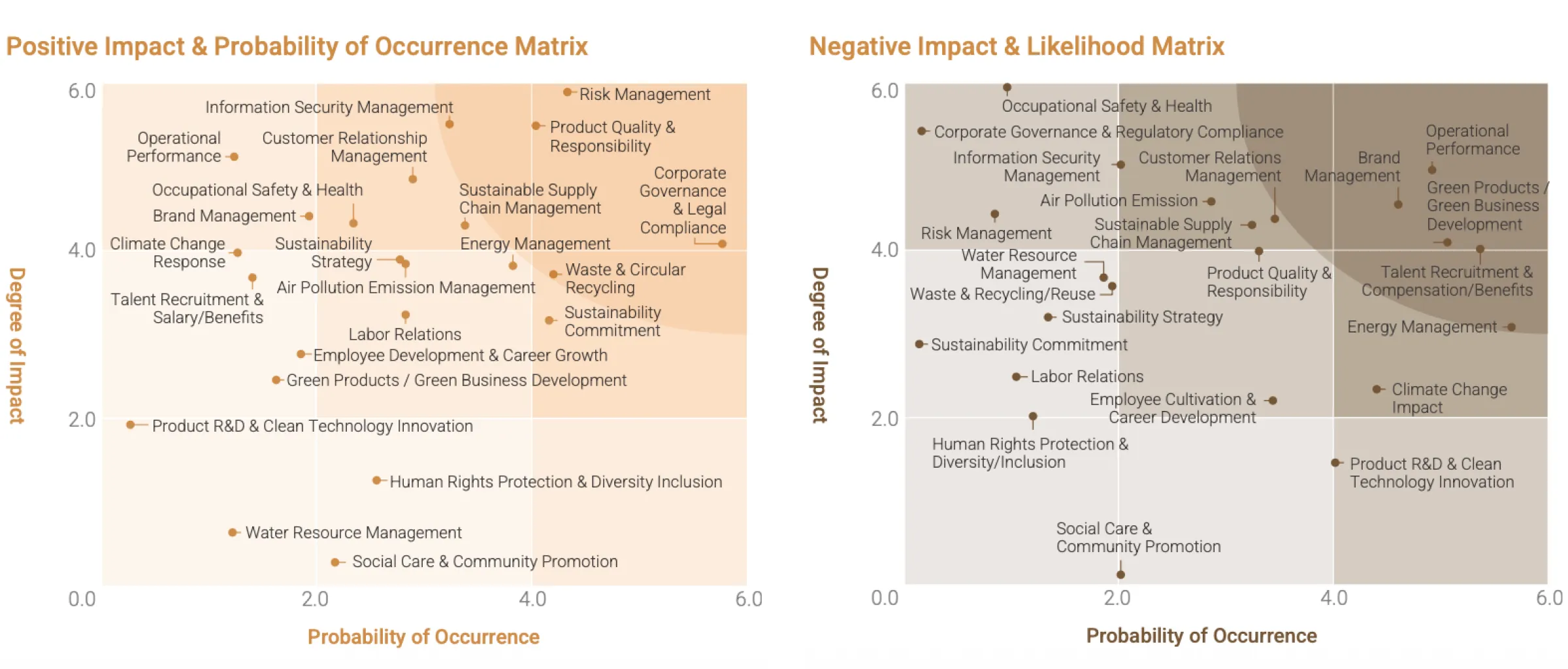





Walsin Lihwa draws on international sustainability standards and norms (SASB, TCFD, CDP), international sustainability ratings (MSCI, DJSI), the United Nations Sustainable Development Goals (SDGs), and industry trends, and through interactive communication with stakeholders-including assessing peer sustainability practices-refined 23 sustainability topics. To understand the materiality ranking of sustainability topics, Walsin Lihwa, in accordance with the GRI 3 definition of materiality, has senior management-based on the Double Materiality principle-assess the degree of positive and negative impact of Walsin Lihwa on corporate operations and the external economy, environment, and people (including their human rights) across the aforementioned 23 sustainability topics, as well as the likelihood of impact events occurring, generating impact scores. It then plots a material topics matrix based on "the degree of positive and negative impact on the economy, environment, and people" and "the likelihood of impact events occurring," compiles the topics with significant positive and negative impacts and the topics of key concern to stakeholders, and, after review by the Sustainability Development Committee and the formulation of management guidelines for each material topic, reports to the Board of Directors for approval. In 2025, Walsin Lihwa identified 14 material topics, in order of: "Risk Management," "Operational Performance," "Corporate Governance and Regulatory Compliance," "Product Quality and Responsibility," "Talent Recruitment and Salary & Benefits," "Brand Management," "Green Products / Green Business Development," "Information Security Management," "Energy Management," "Waste and Circular Regeneration," "Occupational Safety and Health," "Customer Relationship Management," "Sustainability Commitment," and "Labor-Management Relations." Compared with 2024, "Waste and Circular Regeneration," "Energy Management," and "Brand Management" were newly added. For the aforementioned material topics, the affected parties and boundaries inside and outside the organization were defined and further mapped to specific GRI topics, serving as the main disclosure subjects of this report and disclosing Walsin Lihwa's response strategies and current performance. The above 14 material topics are all controlled by each unit and subsidiary, each risk management unit, and the Audit Office in accordance with the "Three Lines of Defense Mechanism for Enterprise Risk Management." For detailed management procedures and control mechanisms, please refer to 3.4 Risk Management and Regulatory Compliance.